
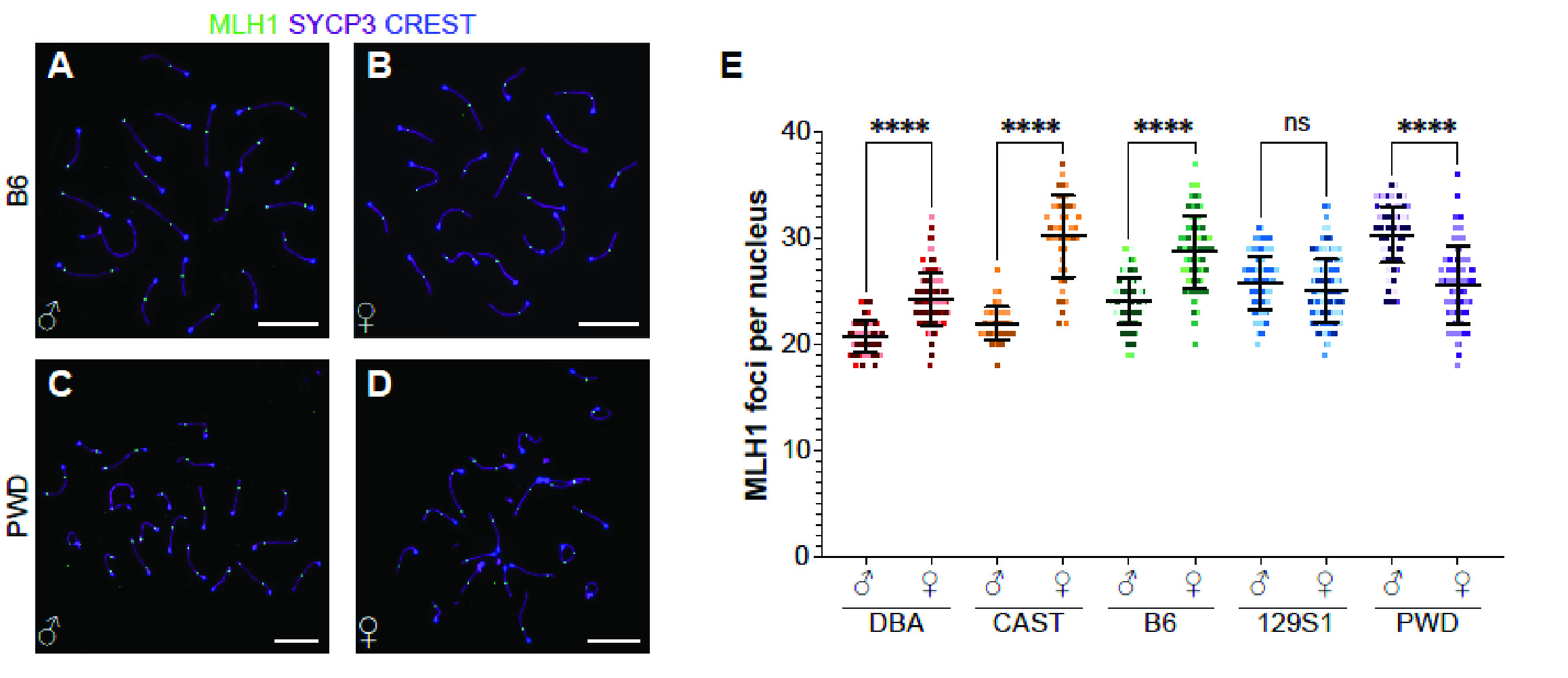
A new study from the Cohen Lab, published in Molecular Biology and Evolution, challenges a long-standing model for how genetic crossovers are controlled during meiosis. Led by Tegan Horan, with Anna Wood and Stephanie Tanis, the study compared crossover formation in males and females across five genetically diverse mouse strains. For decades, differences in crossover number between the sexes were largely attributed to the length of the synaptonemal complex—the chromosome structure on which recombination occurs. Horan and colleagues found that this explanation is incomplete: in the PWD mouse strain, males produce more crossovers despite having shorter chromosome axes than females, revealing that sex-specific regulation of crossover designation and distribution plays a major role in determining recombination outcomes. As Horan told the Cornell Chronicle, “chromosome length couldn't be the whole story. Something else was shaping the process.”
The study also uncovered important differences in how males and females convert early recombination intermediates into mature crossovers and showed that males exhibit stronger crossover interference, the mechanism that spaces crossovers apart along chromosomes. Perhaps most unexpectedly, the researchers found that the relatively rare class II crossover pathway appears to play an outsized role in ensuring that every chromosome pair receives at least one crossover—an essential safeguard against chromosome segregation errors. These findings have important implications for understanding why human female meiosis is particularly vulnerable to errors that can lead to infertility, miscarriage and aneuploid conditions such as Down syndrome, while emphasizing that there is no single universal blueprint for how mammalian meiosis is regulated.