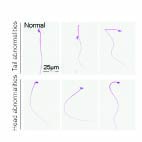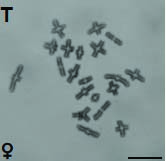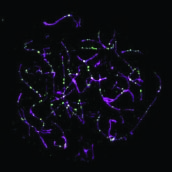

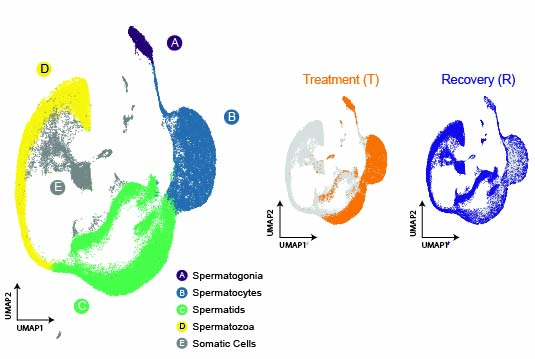
A new study from the Cohen Lab, published in the Proceedings of the National Academy of Sciences (PNAS), provides important proof-of-principle that meiosis can be safely and reversibly targeted for nonhormonal male contraception. Led by co-first authors Stephanie Tanis and Leah Simon, with Paula Cohen as senior author, the team used the small-molecule BRDT inhibitor JQ1 to transiently disrupt meiotic prophase I in mice. Three weeks of treatment suppressed the critical pachytene transcriptional program and halted sperm production, while leaving the spermatogonial stem cell population capable of regenerating the germline. Following withdrawal of the drug, sperm production, meiotic chromosome behavior and gene-expression programs recovered, with full restoration of fertility and fecundity over time.
Importantly, the study went well beyond simply demonstrating reversibility. The researchers examined chromosome recombination, sperm quality, long-term fertility and the next generation, finding restoration of normal reproductive function and healthy, fertile offspring after treatment. As highlighted in the Cornell Chronicle, JQ1 itself is a research tool rather than a candidate contraceptive, but the work establishes meiosis as a biologically defined window that can be temporarily interrupted without permanently compromising fertility. The Cohen Lab is now pursuing new targets acting at the very beginning of meiosis, with the long-term goal of developing a safe, long-acting and reversible contraceptive option for men.